Essay
What are we standing on?
AI amplifies whatever we bring to it, extraction or creation. From the first farms to the first chips, history shows which one leads to human flourishing.
What are we standing on? For many of us, the ground feels like it is shifting beneath our feet. The work we spent decades getting good at is changing faster than we can name it, and the skills that made us valuable are being handed to machines. But maybe the ground isn’t the problem. Maybe it’s the feet we’re standing on.
For years, many of us have measured our value as human beings by what we produce at work. What we could build, design, ship or lead became who we were, and our titles became our identities. If that is what we have been standing on, then we have all been standing on feet of clay. Our true worth goes far deeper, back to the beginnings of our days as hunter-gatherers, when what mattered was how we cared for one another, the stories we told and the things we made together.
What is true of us is true of civilizations. Every civilization builds a statue of itself out of what it values, and every one of them has stood on feet of clay. The image is ancient. In the Book of Daniel, Nebuchadnezzar II, king of Babylon, dreams of a great statue with a head of gold, a torso of silver, legs of iron and feet of clay. A stone ‘cut out without hands’ strikes the feet, and the whole statue crumbles to dust.1 Daniel read the statue from the head down, as a story of decline. I want to read it from the feet up, as a map of human history, and to add one material Nebuchadnezzar could not have imagined: a crown of diamond, for the age of AI we are entering now. The name is a deliberate nod to Neal Stephenson’s novel The Diamond Age.2
Every layer of that statue tells the same story. When a society, or a company, takes more value from people and the earth than it gives back, we see short-term gains and long-term loss; when it gives back more than it takes, we see long-term human flourishing. AI doesn’t choose between the two. It amplifies whichever one we bring to it, and if we choose creation, I believe it can act as a partial equalizer, narrowing the gap between people who have expertise, capital and access and people who don’t.
To track how we have fared as we climb Nebuchadnezzar’s statue, I’ll use a ‘Human Flourishing’ metric. What do I mean by flourishing? Not wealth, and not output. In Incorruptible, Eric Ries argues that profit itself should be redefined as the surplus of human flourishing an organization creates once all of its effects on people are counted.3 Researchers at Harvard’s Human Flourishing Program, building on the economist Amartya Sen, call flourishing the chance to live a life you have reason to value.4 Drawing on both, I’ll score each age on six things:
- Security: enough food, health and safety that survival isn’t a daily question
- Autonomy: real choices about your own life and work
- Mobility: a fair chance to rise beyond the circumstances of your birth
- Connection: close relationships, a community that would notice if you went quiet, and a circle of concern wide enough to include strangers
- Purpose: a role that feels meaningful, where you are valued for who you are and not only for what you produce
- Sustainability: gains that are not paid for by other people, by future generations or by the planet
An age scores well when these reach most people, not just those at the top. That is where extraction and creation show up. Extraction concentrates flourishing in a few hands or borrows it from the future. Creation spreads it, and leaves something behind.
Money alone doesn’t buy it. In 2025, the Global Flourishing Study surveyed more than 200,000 people in 22 countries and found that flourishing did not rise with national wealth: Indonesia scored highest, and Japan, one of the richest, scored lowest.5
Treat the scores in this essay as a heuristic, not a measurement: in each age, the question is who was extracting value, who was creating it, and whether ordinary people ended up with more autonomy, mobility and security than before. Now let’s see how this plays out.
Feet of Clay: The Age of Grain
The cradle of civilization began with clay; it was one of the first materials we shaped into shelters and homes. Readily available and easy to mold, clay gave us homes we could live in right away with little effort, yet it crumbles and is lost over time when exposed to the elements. The first civilizations were built the same way. When archaeologists compare the skeletons of hunter-gatherers with those of the first farmers, the hunter-gatherers were often taller, with stronger bones and fewer signs of malnutrition and disease. Studies of hunter-gatherer societies that survive today suggest that, by some measures, they spend fewer hours working than farmers do. Both findings are debated, but they point in the same direction. So what did we gain with agriculture? Stability, or the illusion of stability anyway. Agriculture let us feel that we controlled our food supply instead of chasing it to the ends of our stamina. In that control we gained the means of extracting value from the earth. But stored grain could be counted, taxed and seized, and whoever controlled the surplus came to control the people who grew it.
The political scientist James C. Scott makes this case in Against the Grain6. Grain, he points out, is visible, measurable, storable and easy to tax. That made it the perfect foundation for the first states: a ruler could count it, collect it and use it to feed soldiers and scribes. Some of the earliest writing we have, pressed into clay tablets in Mesopotamia, is accounting: records of grain, labor and debt. One of the first things we did with the new technology of writing was keep track of what was owed.
This was the time of early conquest. Surplus grain and settled land were worth fighting for, and with them came organized slavery and some of the most brutal treatment of ‘the other’ in the human record, from the territorial wars between Mesopotamian city-states to the Akkadian Empire of Sargon, often called the first empire, around 2300 BCE. Our ancestors were wired for freedom, for storytelling, art and close connection, and we traded much of that for a more consistent food supply. With that trade came leaders focused on conquest and the loss of individual autonomy and choice. We still had some ability to mold our personal existence, yet we were compelled to trade it for survival and security. On the Human Flourishing metric, this was likely a step down from the freedom and connectedness of the hunter-gatherers.
Clay was easy to shape and quick to give us shelter, but it crumbles when the weather turns. So did the first empires.
Legs of Iron: The Age of the Road
As the structure of civilization improved, the brutality of the early clay empires gave way to the law and philosophy of the Greeks and the Romans. Greek philosophers, the Stoics in particular, argued that all people share a common humanity, an early seed of the idea of universal rights. Rome turned law into an institution. Slavery remained everywhere, but in Rome it was not always permanent: enslaved people could be freed, freed people could become citizens, and their children could rise further still. A commercial class grew between the aristocrats and the poor. Roman engineering built tens of thousands of miles of roads and aqueducts that brought clean water to cities, along with a food supply and an economy that spread prosperity to far more people than the clay empires ever had. The Romans were also capable of extraordinary cruelty in the name of stability and control. Both things were true at once.
In 212 CE, the emperor Caracalla issued an edict, the Constitutio Antoniniana, that granted Roman citizenship to nearly every free person in the empire. The historian Cassius Dio, who lived through it, claimed the real motive was revenue: some taxes, such as the inheritance tax, fell only on citizens. That pattern will keep recurring in this essay. A measure aimed at extraction still widened the circle of rights for millions of people.
When the Western Roman Empire fell in 476, the Eastern Roman Empire, which we now call Byzantium, carried on for almost another thousand years. We often gloss over it, forgetting that it outlasted the West by centuries. Under Justinian in the 530s it compiled Roman law into a single code that became the foundation of civil law across much of Europe, and Constantinople became one of the great trading crossroads of the world. By the Human Flourishing metric, it was one of the most durable successes of the Iron Age.
The medieval West belongs in this age too. Serfdom tied most people to the land, but monasteries preserved knowledge, guilds trained craftsmen, and in 1215 Magna Carta put the first written limits on an English king. Then came a grim counterexample to any neat story of progress. The Black Death of 1347 to 1351 killed perhaps a third or more of Europe’s population, and the labor shortage that followed raised wages and loosened serfdom for the survivors. Sometimes flourishing rose not because anyone chose it, but because catastrophe broke the old system of extraction.
By the end of this age, the trade we made in the Age of Grain was beginning to pay off: more people lived under written law, had some path to rise, and could reach roads, clean water and trade. The Age of the Road ended in 1453, when the Ottoman sultan Mehmed II brought giant cannon to the walls of Constantinople and broke them. Iron gave way to gunpowder.
Torso of Silver: The Age of Gunpowder
Silver was literally the money of this age. In 1545 the Spanish found a mountain of silver at Potosí, in present-day Bolivia, and worked it with the mita, a system of forced Indigenous labor that killed workers in enormous numbers. Potosí’s silver paid for European armies and flowed across the Pacific to China, tying the world into a single economy for the first time. Silver’s ‘torso’ was built on extraction from the start.
The Age of Gunpowder also brought a return to confined slavery, harsher in some ways than anything in Rome. Roughly 12.5 million Africans were forced onto ships in the Atlantic slave trade.7 Their slavery was hereditary and defined by race, with almost no path to freedom for them or their children. In terms of mobility, this was a regression to the worst of the clay empires.
A new kind of extractor appeared as well: the company. The Dutch East India Company, founded in 1602, was the first publicly traded company in the world. In 1621, to secure a monopoly on nutmeg, it killed or enslaved most of the people of the Banda Islands. The British East India Company went further and ruled Bengal as a profit center; a famine there in 1770 killed millions while the company kept collecting revenue. Adam Smith would later accuse joint-stock companies like these of ‘negligence and profusion’ with other people’s money.8 When we ask today whether AI companies will create or extract, this is the history we are drawing on.
Yet this was also an age of extraordinary creation. Around 1450, Johannes Gutenberg’s printing press arrived at almost the same moment as gunpowder, and it is the closest historical parallel to AI in this essay. It made knowledge cheap. Within a few generations, books, pamphlets and ideas reached people who had never had access to them. It also brought a century of upheaval, the Reformation and the wars of religion, before the gains settled into the scientific revolution. New crops from the Americas, potatoes and maize, fed population growth from Ireland to China. In Mughal India, the emperor Akbar abolished the tax on non-Muslims in 1564 and promoted tolerance among faiths. And by the end of the age, the philosophy of the Enlightenment gave birth to the rights of man, and common people seized control of their autonomy in the American and French revolutions. In 1787, the first organized campaign to abolish the slave trade began in Britain.
There is a counterexample worth sitting with. After 1600, Tokugawa Japan restricted firearms and enjoyed roughly 250 years of internal peace. Historians debate how deliberate that choice was, but it shows that a society can decide not to scale a technology. Adoption is never as inevitable as it feels in the moment.
Yes, there was much human suffering in this era, as in the eras of the past; the circumstances of one’s birth still dictated most of the opportunities available, and individual choice was still largely controlled by the few. Yet by its end, more people had more choice and food security than at any earlier time in civilization.
Head of Gold: The Age of the Un-thinking Machine
Let’s begin this age with the advent of automation: the first industrial machines, which turned manual labor into repeatable tasks and created the first true economies of scale. In many ways, the early factories were the very definition of short-term extraction: owners took value from workers’ time and health faster than they gave anything back. Yet both mindsets were present from the beginning. In The Wealth of Nations (1776), Adam Smith wrote that ‘consumption is the sole end and purpose of all production’: the producer’s interest, in his view, mattered only insofar as it served everyone else. Two centuries later, Milton Friedman would narrow the purpose of business to increasing its profits.9 That shift, from serving people to serving shareholders, is a small version of the larger story this essay is telling.
At first, extraction won. The economic historian Robert Allen describes ‘Engels’ pause’: from roughly 1790 to 1840, British output soared while workers’ real wages barely moved.10 The gains of the new machines went almost entirely to their owners. Children worked long shifts in the mills until the Factory Act of 1833 began to limit it. Across the Atlantic, the cotton gin, patented in 1793, made slavery more profitable and helped it expand across the American South to feed British looms. The new machines did not end the old extraction; at first they intensified it.
The Luddites of 1811 to 1816 are usually remembered as people who hated machines. They were skilled textile workers protesting how machines were being used: to cut wages, skip apprenticeships and flood the market with shoddy goods. Their complaint was about who captured the value, and it sounds very familiar today.
Then, slowly, creation caught up. At New Lanark in Scotland, Robert Owen ran a cotton mill with schools for workers’ children, shorter hours and decent housing, and it stayed profitable. In 1854, John Snow traced a cholera outbreak in London to a single contaminated water pump, and the city went on to build a modern sewer system. Britain abolished slavery in its colonies in 1833 and the United States in 1865. Around 1910, the Haber-Bosch process made synthetic fertilizer possible; it now helps feed roughly half of humanity, even though Fritz Haber also pioneered chemical weapons. In 1914, Henry Ford doubled his workers’ pay to five dollars a day and turned them into his customers, though he also sent investigators into their homes to check how they lived. By the end of the twentieth century, global life expectancy had roughly doubled, and extreme poverty had fallen from most of humanity to a small minority.
This was also the era in which Charles Babbage designed the Analytical Engine, the first general-purpose computer, and his collaborator Ada Lovelace published the first computer program for it in 1843, though the machine itself was never built. Lovelace was clear about its limits: the Engine, she wrote, ‘has no pretensions whatever to originate anything. It can do whatever we know how to order it to perform.’11 It was an un-thinking machine. In 1950, Alan Turing named this ‘Lady Lovelace’s Objection’ and argued that machines might one day surprise us.12 That day has arrived: today’s AI writes, codes and reasons in ways no one explicitly ordered it to.
Crown of Diamond: The Diamond Age
In 1995, Neal Stephenson published The Diamond Age: Or, A Young Lady’s Illustrated Primer. It imagines a world where machines can build almost anything from raw atoms, and at its center is an object that matters more than any of them: the Primer, an interactive book that teaches and adapts to the child who reads it. It was built for the granddaughter of a wealthy aristocrat. A stolen copy ends up with Nell, a poor girl with every disadvantage, and it changes her life. That is the equalizer story many of us hope AI can tell.
But Stephenson adds a lesson we should not skip. Hundreds of thousands of other copies of the Primer are given to orphaned girls, and they turn out very differently from Nell. The difference is that Nell’s copy was voiced, behind the scenes, by a real human actor who came to care about her. The technology equalized only when a human connection came with it.
The novel also names the choice this essay has been tracing. In Stephenson’s world, most people depend on ‘the Feed’, a centrally controlled supply of matter and goods. The alternative is ‘the Seed’, decentralized technology that anyone could grow for themselves. The Feed is extraction: dependence on whoever controls the supply. The Seed is creation: capability placed in many hands.
We can already see both in AI. On the side of creation, AI tutors are beginning to put something like the Primer within reach of any child with a phone. DeepMind’s AlphaFold predicted the structures of more than 200 million proteins and released them freely to scientists everywhere, work that earned a share of the 2024 Nobel Prize in Chemistry.13 On the side of extraction, we have already lived through a decade of algorithms optimized for engagement rather than well-being, and the same incentives are pulling at AI. The computing power behind the most capable systems is concentrated in a handful of companies. And if the gains of automation flow only to the owners of the machines, we risk a second Engels’ pause, with output soaring while ordinary people wait decades to benefit.
This is what it means to call AI an accelerant and an amplifier. It does not choose between extraction and creation; it multiplies whichever one we bring to it. Like the printing press, it makes something scarce, in this case expertise, suddenly cheap. Who benefits depends on the choices we make in the first few decades, before the habits, laws and business models around AI harden.
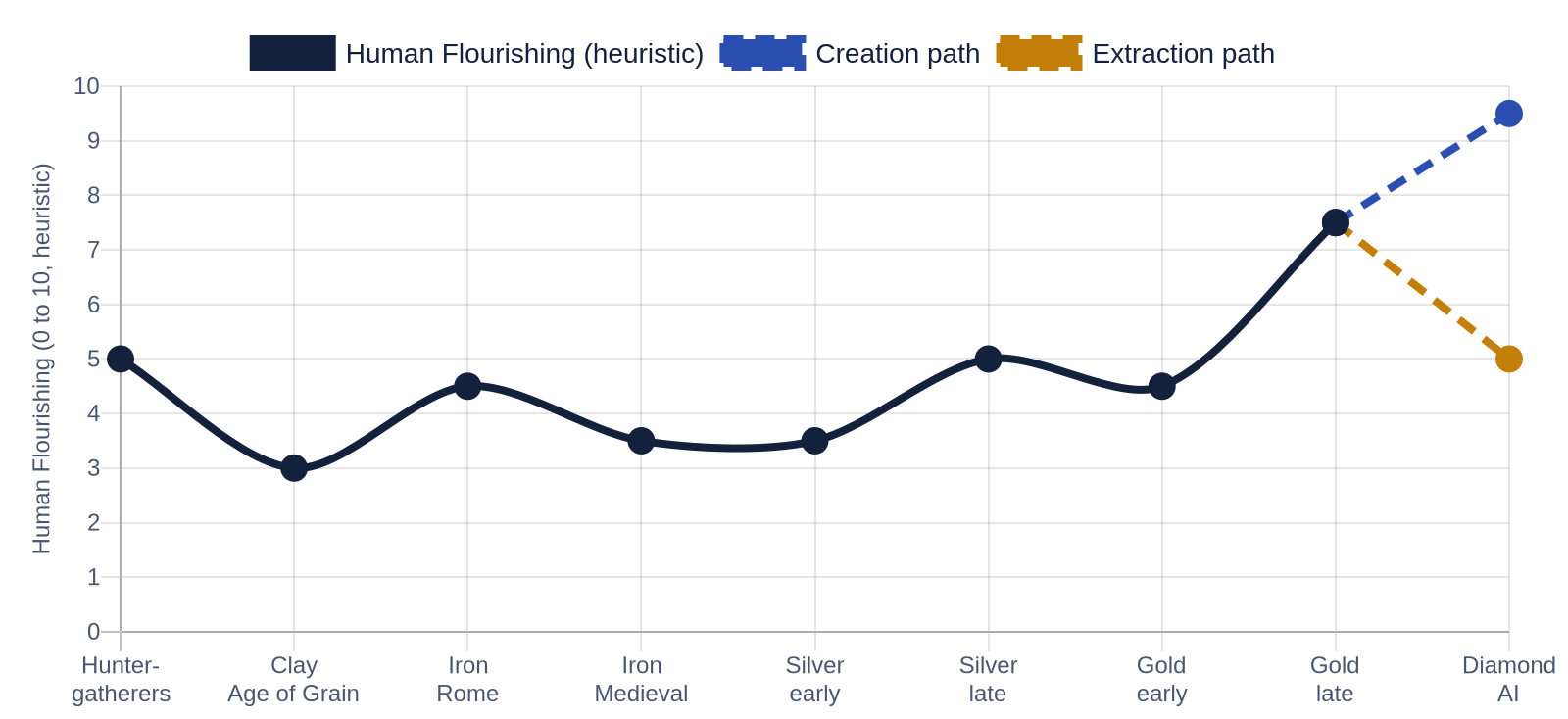
The figure below plots the Human Flourishing heuristic across the ages. The numbers are judgments, not data: each point is a rough score from 0 to 10 for how much autonomy, mobility and security ordinary people had. The shape is the point. The line falls when we first trade freedom for grain, rises slowly through law and roads, dips with the new extraction of gunpowder and early industry, then climbs steeply. At the Diamond Age, it forks.
Conclusion: Feet of Clay, Revisited
In 2009, the biologist E. O. Wilson summed up our situation in one sentence: ‘The real problem of humanity is the following: we have Paleolithic emotions, medieval institutions and godlike technology.’14 Nebuchadnezzar’s statue maps onto it almost exactly. Our medieval institutions are the legs of iron, strong but slow to change. Our godlike technology is the crown of diamond, the hardest material we have ever made. And the feet of clay? Wilson would say they are our Paleolithic emotions. I think they are something more recent: the habit, learned in the Age of Grain and perfected in the factory, of measuring human worth by human output. Beneath that clay is older ground. For hundreds of thousands of years, small bands of hunter-gatherers survived by sharing, caring for one another and telling stories together. Our Paleolithic instincts are not only the problem; they are also the bedrock.
In Daniel’s dream, the statue does not fall because its head is weak. It falls because its feet are made of clay. A diamond crown does not change that; it only adds weight. There is even a literal version of the image: clay is made largely of silicon and oxygen, and the chips that run AI are made of silicon. Our most advanced technology still stands on feet of clay. And the dream ends with a stone ‘cut out without hands’, something no human made, that brings the whole statue down. Whether AI becomes that stone, the force that topples a civilization standing on clay, or the next layer of a statue that keeps rising, is not decided by the technology. It is decided by us.
Short-term extraction and long-term value creation have been competing since civilization began. AI is acting as an accelerant and an amplifier; it holds a mirror to the whole of humanity as it has been. The choice has always been ours. It is time to awaken our sense of autonomy, to regain our sense of purpose and our connection to other humans, to take back control of long-term value creation, and to make AI a force for human flourishing.
marker in each essay and fills the {{...}} slots. Not a page: the build removes it from dist/. Behaviour lives in essay.js. -->Did this land?
Thank you. There are no public counts here; this just tells me what to write next.
Reply to Mark
Thank you. I read every reply.
Get the next essay
You're on the list. The next essay will come to your inbox.
Sources
- The Book of Daniel, chapter 2, verses 31 to 45 (KJV). biblegateway.com
- Neal Stephenson, The Diamond Age: Or, A Young Lady’s Illustrated Primer (Bantam, 1995). wikipedia.org
- Eric Ries, Incorruptible: Why Good Companies Go Bad… and How Great Companies Stay Great (Authors Equity, 2026). Interview with the author, thoughteconomics.com
- Tyler J. VanderWeele, “On the Promotion of Human Flourishing,” Proceedings of the National Academy of Sciences 114(31), 2017; Amartya Sen, Development as Freedom (Knopf, 1999). doi.org · wikipedia.org
- The Global Flourishing Study, first-wave results, Nature Mental Health, April 2025 (more than 200,000 adults in 22 countries), as reported in “More proof that money isn’t everything,” Harvard Gazette, April 2025. news.harvard.edu
- James C. Scott, Against the Grain: A Deep History of the Earliest States (Yale University Press, 2017). wikipedia.org
- The Trans-Atlantic Slave Trade Database, estimates of Africans embarked, 1501 to 1866. slavevoyages.org
- Adam Smith, The Wealth of Nations (1776), Book IV, chapter 8 (“consumption is the sole end and purpose of all production”) and Book V, chapter 1 (on joint-stock companies). gutenberg.org
- Milton Friedman, “The Social Responsibility of Business Is to Increase Its Profits,” The New York Times Magazine, 13 September 1970. nytimes.com
- Robert C. Allen, “Engels’ Pause: Technical Change, Capital Accumulation, and Inequality in the British Industrial Revolution,” Explorations in Economic History 46(4), 2009. doi.org
- Ada Lovelace, translator’s notes to L. F. Menabrea, “Sketch of the Analytical Engine,” 1843, Note G. fourmilab.ch
- Alan Turing, “Computing Machinery and Intelligence,” Mind 59(236), 1950, section 6. doi.org
- The Nobel Prize in Chemistry 2024 (Baker, Hassabis, Jumper), and the AlphaFold Protein Structure Database. nobelprize.org · alphafold.ebi.ac.uk
- E. O. Wilson, in conversation with James Watson, Harvard Museum of Natural History, September 2009, as reported in “An Intellectual Entente,” Harvard Magazine, 10 September 2009. harvardmagazine.com
Further reading
- Jeremy Rifkin, The Empathic Civilization: The Race to Global Consciousness in a World in Crisis (Tarcher/Penguin, 2010). wikipedia.org
- Rutger Bregman, Humankind: A Hopeful History (2020). wikipedia.org
A note on the figure and the evidence
Figure 1 is a heuristic, not a dataset. Each score is a judgment against the six parts of the Human Flourishing metric defined above, and the two Diamond Age points are possibilities, not forecasts. Several claims in the essay rest on contested evidence and are written that way: the comparison of hunter-gatherer and early farmer health and working hours, Cassius Dio’s account of why Caracalla extended citizenship, and how deliberately Tokugawa Japan set firearms aside.